
why-ai-pilots-fail-production-engineering
Product Engineering
MIT found 95% of enterprise GenAI pilots deliver zero ROI. Here's the production engineering playbook — RAG, evals, agents — that gets AI systems live.
Keogram Labs
The Short Answer
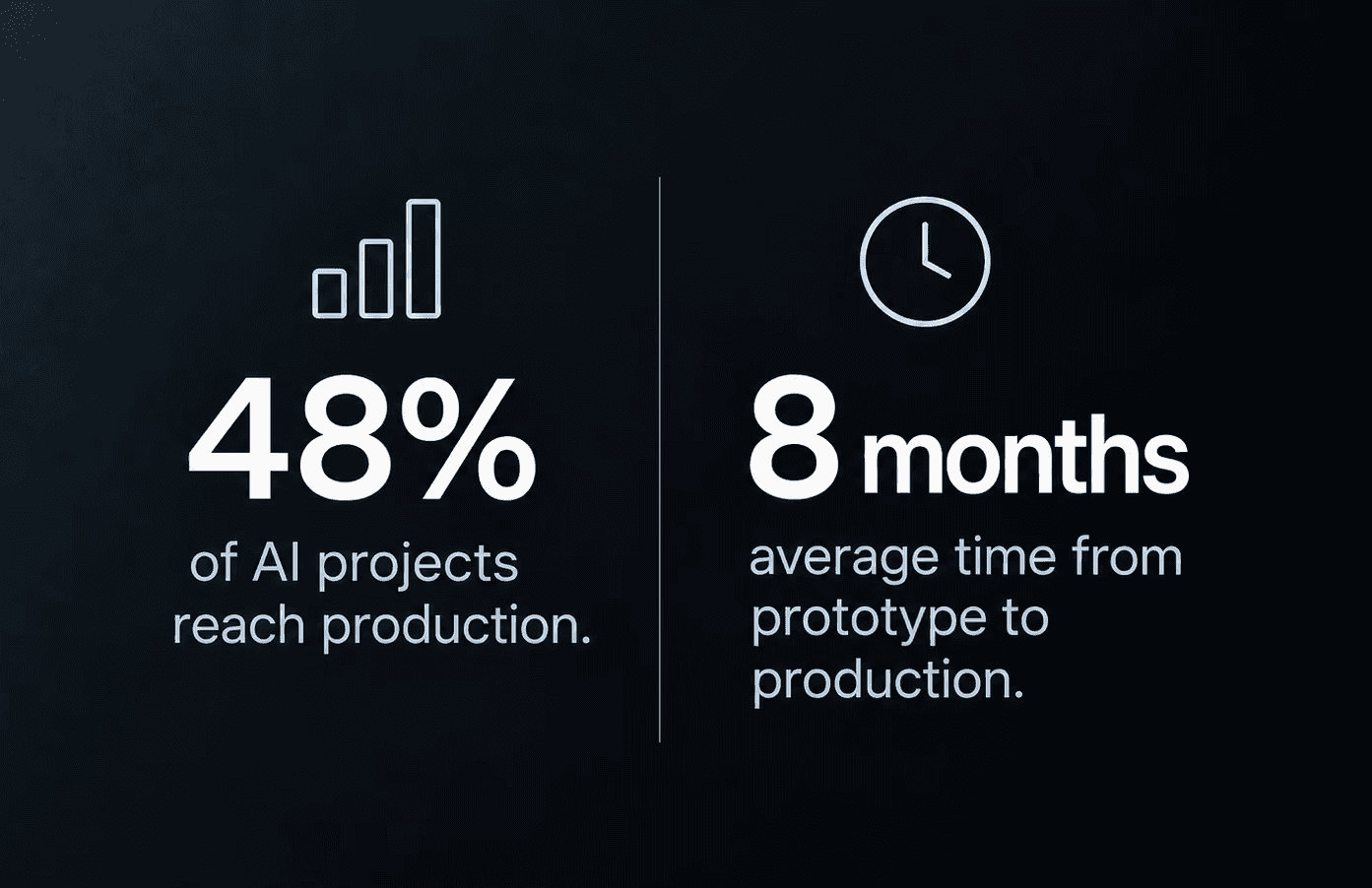
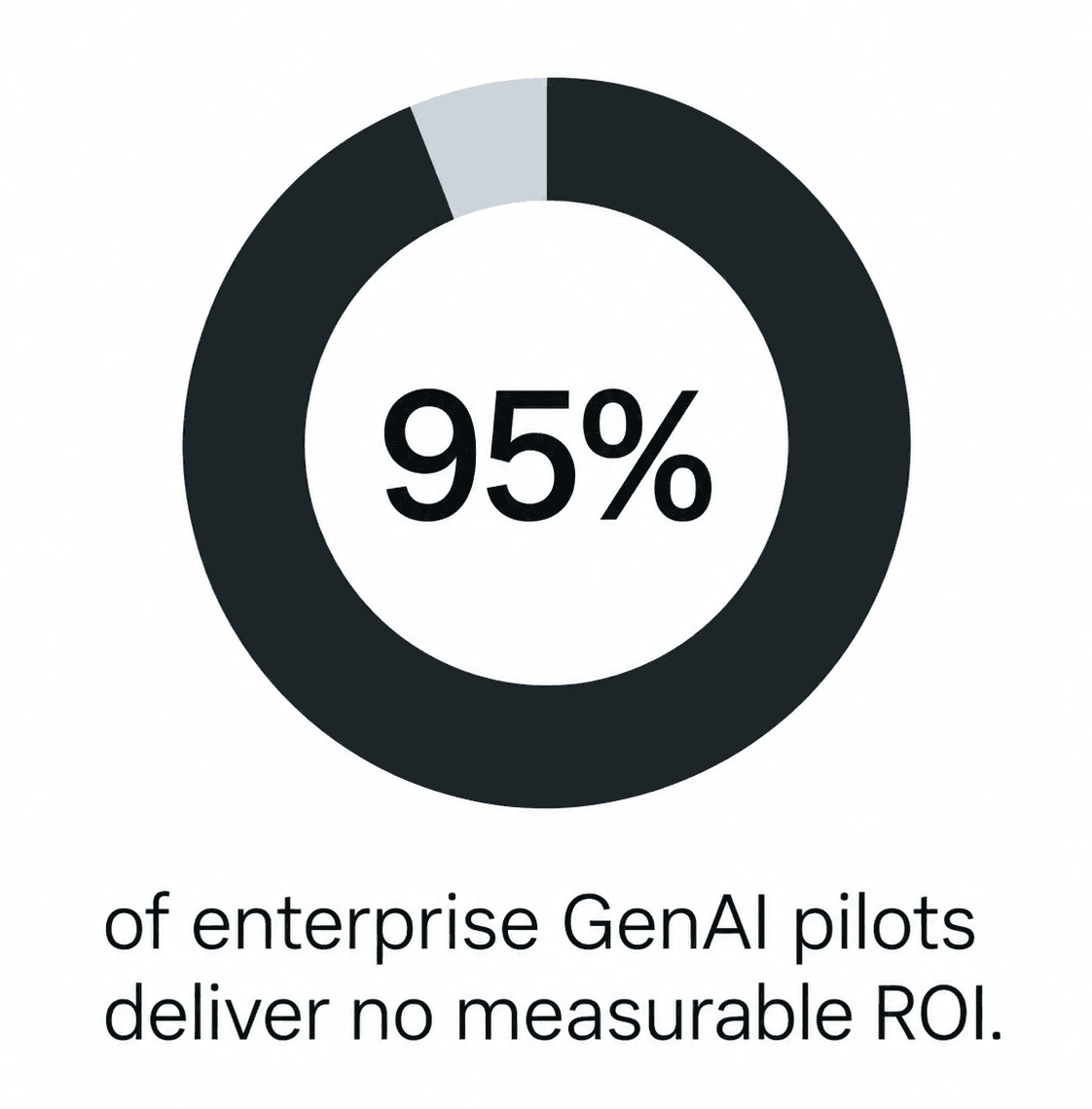
Most enterprise AI pilots fail for a simple reason: they were built as demos. A demo runs in a controlled environment, in front of a forgiving audience. Production is a different animal. It means accuracy on messy real-world data, integration with workflows that already exist, continuous evaluation, and real security and cost controls. The numbers are stark. MIT's 2025 research found that 95% of enterprise GenAI pilots deliver no measurable ROI. Gartner found that only 48% of AI projects ever make it into production, and that even those take eight months on average to get there. The 5% who succeed share one trait. They engineer for production from day one.
Key takeaways
- 95% of enterprise GenAI pilots show zero measurable P&L impact (MIT NANDA, 2025)
- Only 48% of AI projects reach production; the average prototype-to-production cycle is 8 months (Gartner)
- Vendor-partnered builds succeed roughly 2× more often than purely internal builds (MIT)
- The fix is engineering discipline - RAG with evals, governed agents, on-device inference, and workflow-native deployment not a better model.

The Numbers Behind the Pilot-to-Production Cliff
The most-cited data point in enterprise AI right now comes from MIT's NANDA initiative. Its 2025 report, The GenAI Divide: State of AI in Business 2025, analyzed 150+ leadership interviews, employee surveys, and roughly 300 public AI deployments. The finding: despite an estimated $30–40 billion in enterprise generative AI investment, about 95% of pilots delivered no measurable impact on the P&L. Just 5% achieved rapid revenue acceleration.
The report's authors were explicit about the cause, and it isn't model quality. Enterprise tools fail because of a "learning gap": rigid systems that don't retain feedback, adapt to workflows, or improve with use. Generic chatbots achieve high adoption for trivial tasks, then stall the moment real work demands context and customization.
Gartner's data tells the same story from a different angle. The firm predicted at least 30% of GenAI projects would be abandoned after proof of concept by the end of 2025, citing poor data quality, inadequate risk controls, escalating costs, and unclear business value and its subsequent analysis suggests the real figure landed closer to 50%. Gartner also found that only 48% of AI projects make it into production at all, at an average cost of eight months from prototype to deployment.
There is, however, a meaningful silver lining buried in the same research: Gartner's survey of 822 business leaders found early production adopters reporting an average of 15.8% revenue increase, 15.2% cost savings, and 22.6% productivity improvement. The ROI is real. It's the path to it that's broken.
And perhaps the most actionable finding from the MIT report: tools built with external vendor partners succeeded twice as often as internal-only builds (67% vs. 33%). Production AI is an engineering discipline, and disciplines are faster to rent than to grow from scratch.
Why Pilots Fail: Five Engineering Failure Modes
After shipping production AI across government, health, marine, fleet, and embedded hardware, we've seen the same five failure modes repeat:
1. The demo was the goal
A pilot built to impress a steering committee is a different beast from a system that has to survive 10,000 real requests a day. No evaluation harness? No latency budget? No cost model? Then you didn't build a prototype. You built a liability with a sunset date.
2. The model answers; it doesn't know
LLMs generalize fluently and hallucinate confidently. In production, "mostly right" is a bug report. Systems that ship use retrieval-augmented generation (RAG) grounded in your actual documents and data, with citation trails and answer-evaluation scores so outputs are verifiable, not plausible.
3. Nobody owned the workflow
AI that sits beside a process gets abandoned; AI embedded inside a process becomes infrastructure. The highest-ROI deployments MIT identified weren't chatbots, they were back-office automation: document processing, filing workflows, operations. That's an integration problem, not a modeling problem.
4. Data quality was a pilot-phase afterthought
Gartner names poor data quality as a top reason projects die post-POC. Production AI needs OCR and document intelligence pipelines that normalize messy, scanned, multi-format inputs before they ever reach a model, plus active data governance, not a one-time cleanup.
5. Costs, privacy, and latency were discovered in production
Cloud-only inference at pilot scale is cheap. At production scale, per-token costs compound, network dependency becomes a failure mode, and regulated data can't leave the building. Systems engineered for scale use model routing, caching, and on-device LLMs where latency, connectivity, or privacy demands it.

The Playbook the 5% Use: Six Production-Grade Patterns
So what does "engineered for production" look like in practice? These six patterns run through nearly everything we've shipped at Keogram Labs, from the AI platform inside 1,000+ low-speed vehicles to filing systems sitting in government offices:
Pattern 1: RAG with evals, not vibes
Production RAG is really a data engineering problem. Chunking strategy, embedding selection, hybrid search, reranking. Above all, a continuous evaluation suite that scores answer correctness and retrieval precision against a golden dataset. No evals, no production.
Pattern 2: Custom agents with guardrails, not autonomy theater
Useful agents are narrow and bounded. Structured interviews, document processing, fleet telemetry triage. They work inside defined permissions, log every action, and hand off to a human when confidence drops. Governance is a feature, not paperwork.
Pattern 3: On-device LLMs where it matters
For vehicles, field devices, and privacy-sensitive workloads, inference runs at the edge: no network dependency, no data egress, millisecond latency. Architecture decisions about where the model runs are as important as which model runs.
Pattern 4: Document intelligence (OCR) as the front door
Most enterprise knowledge is trapped in PDFs, scans, forms, and mail. A production system starts with high-accuracy OCR and extraction pipelines that turn unstructured documents into AI-ready data.
Pattern 5: Workflow-native deployment
The system lives inside the tools people already use the filing portal, the fleet dashboard, the hiring workflow with human-in-the-loop checkpoints. Adoption is designed, not hoped for.
Pattern 6: FinOps from day one
Token budgets, model routing (small models for simple tasks, large models for hard ones), prompt caching, and cost-per-transaction dashboards. Gartner is blunt: escalating TCO kills technically successful projects.
A Production-Readiness Checklist Before You Greenlight Any Pilot
A named business metric the system must move (not "efficiency" - a number)
Evaluation harness with a golden dataset and correctness thresholds
Integration plan into the existing workflow, with a human checkpoint
Data pipeline: quality, access controls, and document extraction
Latency, uptime, and cost budgets with monitoring wired in
Decision on cloud vs. on-device inference, made on evidence
A build-vs-partner analysis (MIT's data says partnering roughly doubles your odds)
Frequently Asked Questions
What percentage of enterprise AI pilots reach production?
Only about 5% of enterprise GenAI pilots deliver measurable business value, per MIT's 2025 State of AI in Business report. Gartner's broader analysis of all AI projects (not just GenAI) puts the production rate at 48%, with an average eight-month prototype-to-production cycle.
Why do most enterprise AI pilots fail?
Not because of weak models. MIT attributes the 95% failure rate to a "learning gap": tools that don't adapt to workflows, retain feedback, or integrate deeply into real processes. Gartner adds poor data quality, inadequate risk controls, escalating costs, and unclear business value as the top abandonment drivers.
What is the pilot-to-production gap?
It's the chasm between a system that works in a controlled demo and one that survives real operations: messy data, demanding users, security requirements, latency constraints, and compounding cloud costs. Pilots are built for the first environment; production systems are engineered for the second.
Is it better to build AI in-house or partner with an engineering studio?
MIT's research found vendor-partnered tools succeeded about twice as often as internal-only builds (67% vs. 33%). Partner when you need production discipline fast (MLOps, evaluation, edge deployment), and build internal capability in parallel rather than gating your first system on it.
What technologies do production AI systems actually use?
The proven stack: RAG for grounded answers with citations; custom agents with bounded permissions for multi-step work; OCR and document-intelligence pipelines for unstructured inputs; workflow automation for integration; and on-device LLMs where latency, connectivity, or privacy rule out the cloud.
How do you measure ROI from production AI?
Define the business metric before the pilot, instrument it in production, and track cost per transaction alongside it. Gartner's surveys show early adopters averaging 15.8% revenue lift, 15.2% cost savings, and 22.6% productivity gains. But only when projects are tied to specific, measurable outcomes from day one.
The Bottom Line
The GenAI Divide isn't a model problem, a budget problem, or a talent shortage. It's an engineering maturity problem, and it's solvable. The 5% who ship don't have access to better AI than the 95% who stall. They just refused to confuse a demo with a deployment.
Keogram Labs is an AI product engineering studio that designs, builds, and ships production AI systems custom agents, RAG, on-device LLMs, OCR, and workflow automation for enterprises and startups across government, health, marine, fleet, and beyond. If your pilot is stuck on the wrong side of the divide, let's talk.
Sources
MIT NANDA, The GenAI Divide: State of AI in Business 2025 (via Fortune, Aug 2025)
Gartner, Gartner Predicts 30% of Generative AI Projects Will Be Abandoned After Proof of Concept by End of 2025 (Jul 2024); Why 50% of GenAI Projects Fail (Jan 2026)
Gartner survey of 822 business leaders (Sep–Nov 2023): 15.8% revenue increase, 15.2% cost savings, 22.6% productivity improvement
Keogram Labs - AI product engineering studio. Enterprise-grade AI software, built to hold up in real operations at real scale.
Have a product in mind or looking for the right engineering partner? We'd love to learn more about your project and explore how we can help.
